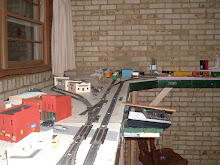
It's been a while since I posted anything. I am most proud that a guest saw my layout in action last night. She exclaimed, "It's REAL!" High praise, I thought. Nancy then went on to recount how she recognized some of the cars from her growing up in the west. I was thrilled that a non-modeler saw some reality in my humble layout.
At church, a lady who found out I was a modeller was very interested in my layout. She's a commercial illustrator, and she wants to look over the La Veta Pass Route. Talk about pressure. Still, I invited her to visit the layout, or even the blog.
On the route, I finally finished wiring the switches. Now, the Coors yard is fully wired. The train person can throw the switches from her post, while the engineer works the locomotive. I feel like I have accomplished something in the last few weeks!
Operationally, I have been making progress, reducing the number of moves it takes to handle ever larger cuts of cars. It is possible to handle six car trains now. But, I do have to plan out the moves in advance. It's still a challenge. I like that though. And, spending time with my oldest daughter who is learning the train person's job is a real treat. No photos to upload tonight.
Sunday, December 9, 2007

Sunday, September 30, 2007
Weekly Update

What a couple of weeks! First, I finished the Coors yard. In theory it will hold 12 cars. But, the rule has always been that a yard is full when it is half full. This holds true for Coors as well. Second, I got most of the ballast down. There is one spot on the Monte Vista passing siding that is not ballasted yet, as I am considering putting in a turnout to a long off spot track. No decision on that as yet. I also soldered in some power feeds to help a couple of spots where I was losing voltage. I added a power trunk line under the track to make it easy to connect feeders and to accomodate the eastern extension when I build that. The same system will support the western extension, which is a higher priority. The photo shows Coors yard with three tracks. From left to right, Grain Loading, Departure, Arrival. Ultimately, these will get numbers as is D&RGW prototypical practice. In the center of the photo, you can see the potato track with three reefers. Maximum capacity is four, but the fourth spot is not accessable to the loading dock. The potato track, will probably get numbered spots soon. Finally, to the right, you can see the tail end of a cut of covered hoppers heading east toward Alamosa.
Most of the time since my last report has been spent on operations. I have smoothed out the process around Monte Vista. Six and even seven car shipments are now well within my capability. There are three off spots, two on the strap siding and one adjacent to the depot. My original thinking on the depot was not for that siding to be for an industry. Now, I may make it a team track. This is certainly prototypical for the Rio Grande.
Wednesday, September 12, 2007
Electrical Update
Last night, a persistent problem with track power finally got my attention. When laying the track, I put in four atlas rail joiners with power lines attached. I know, purists insist on soldering power wires to the track and just using rail joiners to hold the track together. But, I have always been satisfied with the Atlas power joiners and had some, so I used them. Well, last night, I finally got around to hooking the second pair up to the power distribution block. What a difference! No more stalling on the west end crossover. No more stalling on the "X" section.
Sunday, September 9, 2007
A weathered reefer.

Here is a Santa Fe reefer, that I weathered. It's an Athearn model. I saw one with the rusty roof panels driving past a rail yard a few days ago, and thought I'd give a try at doing the same thing.
Sunday Update

I painted on some streets. I used some paint that Home Depot mixed especially for the job. I took paint chips to their parking lot and with Sophie, we picked the one that was a closest match for the asphalt. HD mixed up a quart of paint. Probably enough to paint every street in my part of Colorado and then some.
The street is an actual four inches wide. That is only 31 scale feet. As you can see, there is room for two cars to pass and for parking on both sides of the street.
Saturday, September 8, 2007
Derailments.
Last night, I had my second try at operating the Pass. One problem repeated from the first try. A consistent derailment on the curve between Red-E-Mix and the passing siding in town. It was only a problem for 57' reefers. But, it was aggravating. So, I stopped operating and called in the track gang. I found the problem, a kink in a joint. A slight track realignment and all is well! This confirms a lesson from previous layouts, never ballast down the track until all the kinks are worked out.
The La Veta Pass
After a one year break from model having my own model railroad, I built the La Veta Pass route over the summer of 2007. I like the Denver & Rio Grande Western Railroad. It brings back fond memories of ski trips to the Colorado mountains. Further, I like its operations. Lots of coal, and relatively short fast freights. Ideal for a HO model, if you ask me. The aspect of model railroading I like best is operations, specifically switching operations. There are two spots on the D&RGW where there is a lot of industrial switching, Denver on the East Denver Belt, and the La Veta Pass route, specifically from Alamosa west and south.
Because my previous layout was modeled around the East Denver Belt, I was looking for a new challenge. La Veta provides that challenge while meeting my desire for switching. There are several likely spots on the pass for good modeling. First, there is Alamosa with two yards, some industries and a tourist passenger train operation. In prior years, it would be possible to model narrow gauge steam in Alamosa as well. I model more or less the present day. More on that for another post.
The next possibility is not really on the Rio Grande, but around Center, Colorado which is served by a short line, the San Luis Central. The SLC has only two locomotives but lots of rebuilt mechanical reefers. I did not go with the SLC even though it would be a great little railroad for modelling as I wanted to stay with the Rio Grande.
The third possibility is the interchange between the Rio Grande and SLC at Sugar Junction, Co. There's a "Y", a three track yard and the SLC car shops. On the Grande side of the interchange, not far away in Zinzer there are some industries to model.
Finally, the possibility I chose is Monte Vista. Monte Vista has several industries, mostly agri-business that rail ship. Coors has two elevators, one of which will be included in my world. there are two potato shipping warehouses and some other shippers. All in all, a good excuse for mechanical reefers and covered hoppers. During D&RGW and later Union Pacific ownership this was the preserve of GP-40s. As I have two excellent Atlas GP-40s and two older but good running Athearn GP-40-2s I have chosen to model this area in late UP years, or if you like the late D&RGW years. In my alternative history, the D&RGW is the surviving railroad in the western merger frenzy, not the UP.
Because my previous layout was modeled around the East Denver Belt, I was looking for a new challenge. La Veta provides that challenge while meeting my desire for switching. There are several likely spots on the pass for good modeling. First, there is Alamosa with two yards, some industries and a tourist passenger train operation. In prior years, it would be possible to model narrow gauge steam in Alamosa as well. I model more or less the present day. More on that for another post.
The next possibility is not really on the Rio Grande, but around Center, Colorado which is served by a short line, the San Luis Central. The SLC has only two locomotives but lots of rebuilt mechanical reefers. I did not go with the SLC even though it would be a great little railroad for modelling as I wanted to stay with the Rio Grande.
The third possibility is the interchange between the Rio Grande and SLC at Sugar Junction, Co. There's a "Y", a three track yard and the SLC car shops. On the Grande side of the interchange, not far away in Zinzer there are some industries to model.
Finally, the possibility I chose is Monte Vista. Monte Vista has several industries, mostly agri-business that rail ship. Coors has two elevators, one of which will be included in my world. there are two potato shipping warehouses and some other shippers. All in all, a good excuse for mechanical reefers and covered hoppers. During D&RGW and later Union Pacific ownership this was the preserve of GP-40s. As I have two excellent Atlas GP-40s and two older but good running Athearn GP-40-2s I have chosen to model this area in late UP years, or if you like the late D&RGW years. In my alternative history, the D&RGW is the surviving railroad in the western merger frenzy, not the UP.
Subscribe to:
Comments (Atom)