After a one year break from model having my own model railroad, I built the La Veta Pass route over the summer of 2007. I like the Denver & Rio Grande Western Railroad. It brings back fond memories of ski trips to the Colorado mountains. Further, I like its operations. Lots of coal, and relatively short fast freights. Ideal for a HO model, if you ask me. The aspect of model railroading I like best is operations, specifically switching operations. There are two spots on the D&RGW where there is a lot of industrial switching, Denver on the East Denver Belt, and the La Veta Pass route, specifically from Alamosa west and south.
Because my previous layout was modeled around the East Denver Belt, I was looking for a new challenge. La Veta provides that challenge while meeting my desire for switching. There are several likely spots on the pass for good modeling. First, there is Alamosa with two yards, some industries and a tourist passenger train operation. In prior years, it would be possible to model narrow gauge steam in Alamosa as well. I model more or less the present day. More on that for another post.
The next possibility is not really on the Rio Grande, but around Center, Colorado which is served by a short line, the San Luis Central. The SLC has only two locomotives but lots of rebuilt mechanical reefers. I did not go with the SLC even though it would be a great little railroad for modelling as I wanted to stay with the Rio Grande.
The third possibility is the interchange between the Rio Grande and SLC at Sugar Junction, Co. There's a "Y", a three track yard and the SLC car shops. On the Grande side of the interchange, not far away in Zinzer there are some industries to model.
Finally, the possibility I chose is Monte Vista. Monte Vista has several industries, mostly agri-business that rail ship. Coors has two elevators, one of which will be included in my world. there are two potato shipping warehouses and some other shippers. All in all, a good excuse for mechanical reefers and covered hoppers. During D&RGW and later Union Pacific ownership this was the preserve of GP-40s. As I have two excellent Atlas GP-40s and two older but good running Athearn GP-40-2s I have chosen to model this area in late UP years, or if you like the late D&RGW years. In my alternative history, the D&RGW is the surviving railroad in the western merger frenzy, not the UP.
skip to main |
skip to sidebar
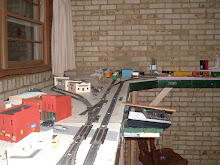
From the west looking east. This gives a general impression of the overall layout.
An ongoing view of my HO world. The La Veta Pass route extends from Walsenburg, Colorado westward. My model world is focused on Monte Vista, Colorado.

From the west looking east. This gives a general impression of the overall layout.
No comments:
Post a Comment